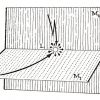
The pattern underlying [the creative act] is the perceiving of a situation or idea, L, in two self-consistent but habitually incompatible frames of reference, M1 and M2. The event L, in which the two intersect, is made to vibrate simultaneously on two different wavelengths, as it were. While this unusual situation lasts, L is not merely linked to one associative context, but bisociated with two.
I have coined the term ‘bisociation’ in order to make a distinction between the routine skills of thinking on a single ‘plane,’ as it were, and the creative act, which … always operates on more than one plane. The former can be called single-minded, the latter double-minded, transitory state of unstable equilibrium where the balance of both emotion and thought is disturbed.
Arthur Koestler’s seminal theory of “bisociation” explaining how creativity in humor, art, and science works.