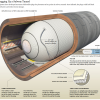
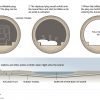
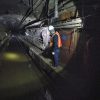
One way to adapt subways to flooding: balloons.
“The goal is to provide flooding protection for transportation tunnels,” said John Fortune, who is managing the project for the federal Department of Homeland Security’s Science and Technology Directorate.
The idea is a simple one: rather than retrofitting tunnels with metal floodgates or other expensive structures, the project aims to use a relatively cheap inflatable plug to hold back floodwaters.
In theory, it would be like blowing up a balloon inside a tube. But in practice, developing a plug that is strong, durable, quick to install and foolproof to deploy is a difficult engineering task, one made even more challenging because of the pliable, relatively lightweight materials required. Via
I gave a lecture to undergrads the other day at Westfield State University. I was terrified. Most of my talks are to professionals and lawyers. But undergrads? Yikes! I was afraid they’d eat me alive!
It went surprisingly well. The students were energetic and pumped to talk about cities, climate change, and infrastructure. The professor, a good friend, was miffed that the students asked me more questions than her on a daily basis. “There’s a trick,” I revealed to her. “Wait 7 seconds after you ask, “Any questions?”. This will give the audience time to reflect and form a question.” I digress.
We discussed damage from Hurricane Sandy. And we chatted about how to adapt New York City’s infrastructure to these bigger storms that we’re seeing. Two very smart students asked about why subway tunnels flood so easily. From my repertoire of engineering solutions (and admittedly slow recall), I described two ways cities are updating their tubes.
The first is to reinforce the subway’s walls and install better pumps. Most walls were built from stone and mortar, then covered with tiles in the 1950s or earlier. So, now, they’re leaky and crumbling. The other way is to raise the entrances to the tunnels. That way, the flood water would not be able to flow down the escalators. Obviously neither are very cheap, but these solutions are not a deal breaker either.
Since Hurricane Sandy, The NYTimes has been running a series of adaptation-related articles. Several articles asked tough questions like, why are we insist on living in risky areas? And why does the federal government incentivize cities to rebuild in those dangerous areas? I’ll post some links soon.
Meanwhile, check out this fancy design idea to plug tunnels in the event of a flood.Alarge balloon is installed into the side of a wall. When there is a threat, the train stops service, the balloon plops down on the track, and then proceeds to inflate.
There are dozens of problems with this system. “Who pays?” and how to test it immediately come to mind. Will fares go up to pay for these balloons? What happens if one fails and there are workers in the tunnel?
What do you think? Will these thingamabobs work?