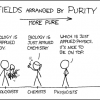
It’s true. I study Biology and end up doing Chemistry. I study Chemistry and end up doing Physics. It all comes down to Maths in the end.
No honestly, I’ve been using concepts from my Further Maths A2 and Physics GCSE classes to help me understand concepts in Chemistry and Biology at degree level. I was thinking of molecular orbital theory with complex numbers, and now I’m doing mechanics and quantum mechanics in Chemistry. Ok this was a little rant, but essentially Maths is the purest way of understanding the world around us. None of that imprecise wordy mumbo-jumbo that’s always misconstrued.
Something about this XKCD comic has always vexed me. While it at one and the same time jokes about the hierarchy of the sciences it is regularly posted on tumblr as a legitimate ordering. It drips with the positivism that all can be recursively deferred to a subject higher up (there is no movement in the opposite direction), as if the world can be so neatly compartmentalized and ordered. As if each discipline not only deals with something ‘separate’ but rather also is an extended application of another towards a new object. What it leaves out, however, is the relationship to the humanities and their implication in this apparent ordering.
It was only this morning in rereading Homo Academicus I found why it vexes me:
In this figure Bourdieu summarizes the division between theoretical (the pure) and empirical (the impure) and how these forms of academic classification doubly subordinate sociology. It covers not only the science side as done by the XKCD comic but incorprotes consideration of the humanities – or in this case the ‘arts and social sciences’ in line with how the faculties were ordered in the case he was researching. Here instead of a graphic of ‘the sciences as according to Sheldon Cooper’ we have a move towards the social basis of the value ascribed to the disciplines and why they present themselves as more ‘pure’ or ‘impure’. It is these classifications and the changing balance of the relationship between the sciences and the arts (the increasing value given to the former in the reorganisation of the university) which Bourdieu then argues is a basis for the challenge the social sciences are seen by philosophers in having to philosophy.
Edit: I think this graph and discussion in this chapter of Homo Academicus provides a new direction in which to approach Bourdieu’s critique of the tendency to dismiss empirical work and how the importance of theoretical-empirical work also serves as a device to liberate the social sciences when reflexively turned back on itself as opposed to deferring to the apparent legitimacy of other disciplines in delineating sociology’s area and limits of competence.

saved for further consideration. I have read only one Bordieu volume, on the logic of practice, in a group with heterogenous theoretical formations. since I first received exposure to fields through physics, that is where my sense-making wanted to locate/relate fields. others in the group located them elsewhere. epistemological differences were expressed.