Organic transistors for brain mapping | KurzweilAI
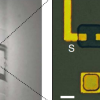
To improve brain mapping, a group of French scientists have produced the world’s first biocompatible microscopic organic transistors that can amplify and record signals directly from the surface of the brain, building on prototypes developed at the Cornell NanoScale Science and Technology Facility (CNF).
This is the first in vivo use of transistor arrays to record brain activity directly on the surface of the cortex using electrocorticography (ECoG). This is a ten-fold improvement in signal/noise quality compared with current ECoG electrode technology, the scientists say.
In epileptic patients, ECoG recordings help to scout brain regions responsible for seizure genesis. For patients with brain tumors, recordings help to chart the brain for tumor removal. In addition, electrical recordings of neuronal activity are being used in brain-machine interfaces to help paralyzed people control prosthetic limbs.
However, neurons and brain networks generate small electric potentials, which are difficult to extract from noise when recorded with classical electrodes made of metals. In addition, today’s ECoG amplifiers are bulky and placed outside the skull, where the signal degrades.
These new biocompatible microdevices are flexible enough to go inside the brain and follow the curvilinear shape of the brain surface.