Introduction to Macromolecules
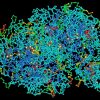
Earlier, we talked about amino acids and how although they’re pretty simple structures, they can join up and build grander molecules called proteins (pictured above). Proteins in turn are part of a group called macromolecules.
Macromolecules are exactly what they sound like: big, complex molecules composed of smaller subunits. There’s an enormous array of possible combinations of subunits, making for an enormous array of possible macromolecules.
Macromolecules are also known as polymers, and the smaller units are known as monomers. Monomers are usually joined up in a linear fashion, and new units are only added onto one end, giving the polymer a direction. So, macromolecules display polarity—i.e., they have unique poles.
Individual monomers are joined by covalent bonds, which are formed and broken through condensation or dehydration reactions. These reactions are pretty simple—basically, a water molecule is either added or removed from a link by specialised enzymes, thus making or breaking it.
There are three classes of macromolecules:
- Nucleic acids, such as DNA and RNA, made up of nucleotides joined by phosphodiester bonds
- Proteins, which as we know are made up of amino acids joined by peptide bonds
- Polysaccharides (such as carbohydrates), which are monosaccharides joined by glycosidic bonds
Note that phosphodiester, peptide and glycosidic bonds are all types of covalent bonds. We’ll go through all three of these macromolecule classes over the next week.