New from @robertjparkin over on our FACE work blog:
How To Detect Communities Using Social Network Analysis
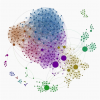
In it, Rob explains the network diagram pictured above:
Let’s start by revisiting the ego network from my Facebook graph that we investigated in the previous blog.
Here nodes are portioned by modularity, with each node belonging to a separate cluster or community, and coloured accordingly. For many of the separate and very distinct clusters on the edges of the network, it shouldn’t come as a surprise that these people belong to their own community.
What is interesting is within the main component, where without the colour coding it’s hard to see any clearly divided partitions. But now we now have four different communities (blue, brown, purple & maroon-ish). So the question is, are these 4 different groups just statistical figments of the network structure? Or do they relate to anything real about the relationships between the people involved?
- The blue community is made up of people I met at school, all around my age (17% of the network).
- The brown community is people I went to school with, but also lived close to where I grew up (9% of the network).
- The maroon community also went to school with me, but all at least a year older that me (7% of the network).
- The purple community is people I attended college with directly after finishing school (also 17% of the network).
This is a great example of how we can segment individuals by very subtle differences, simply by analyzing the structure of the connections they share.
But how could a network “know” these things about my friends? Well, it’s all based on the connections they have with each other. People who were in the same yeargroup at school are more likely to know each other, and therefore be friends on Facebook – so that’s what connects the real world to the network relationship.
This got me thinking more about brands and communities:
A community is most often defined as a group of individuals living in the same geographical location. It can also be used to describe a group of people with a shared characteristic or common interest: the research community, for example. Within the social sciences, communities are often understood as something socially and symbolically constructed – for example, the “imagined community” of the nation state (Benedict Anderson, 1983).
Using social networks analysis we define communities differently – by looking at how people are connected to each other through who follows whom, or who retweets whom – and clustering these into similar groups. So it is a statistical measure of connectedness, and it’s not based directly on whether these people would recognize themselves as being part of the same community.
However, what’s so fascinating about networked community detection is that the communities it identifies very often DO have significant real-world meaning – as demonstrated by Rob’s analysis of his Facebook friends – and can help us explore what it is that joins a community together.
At FACE we’ve done a number of network analysis projects, sometimes for PR (especially with Twitter), but also for internal use, helping brands understand the audience they’re talking to on Twitter.
What I’d like to see is more companies going public on their network analysis, illustrating their audiences back to their followers.
In part because it’s important to give back to the commons, the shared value that we all create through posting on Twitter. Twitter legally own this data, and there’s a fairly well-recognised value exchange in that users essentially sell the information value of their content in exchange for getting Twitter free. And speaking for myself, I certainly get a vast amount of value from using Twitter.
However, one thing we might say distinguishes a real community from just any old group of people is that relationships exist beyond the purely economic. There’s some degree of trust, and a greater degree to do favours. It’s called prosocial behaviour, and it stems from altruism rather than an expectation of immediate return. People give to their community.
Brands need to think more about how they can give to their communities. They get a lot of value from having communities – loyal purchasers and word-of-mouth advocates. And one way they might give back is by sharing insights and visualisations and research, the kind of thing that individual people just can’t do, or create, or find out – but might like to know and see. Like an understanding of the shape & dynamics of the community they’re part of.
Ideally I’d like to see a LOT more open research.
I just did a social media study on the different types of sustainability that the client is talking about sharing & publishing in this way, and that’s really exciting. Of course some research can’t be shared publicly because it’s strategically sensitive – but social media research, built on the commons of open data APIs, doesn’t tend to be so. So why not publish it, and give back insights and learning to the community who generated it?
The second reason to publicly share community visualisations is because, as we said, community isn’t just about shared interests but a shared imaginary, a shared recognition that “We are part of the same group.”
Sharing social network visualisations – illustrating that group as an entity, a multicoloured digital jellyfish – could be one tool for a brand to make real “customer community” beyond the jargon of a thousand Powerpoint decks. The visualisation illustrates the audience as a whole, makes it seeable, thinkable, comprehensible as a unit. It helps people see themselves as part of something bigger.
This happens already – the nod of recognition when you see someone with the same bike or dress as you. It’s a recognition that you have something in common, as expressed by your purchasing choices. (This may or may not be something you feel is a good thing, but that critique is another blog post.)
So what a social network visualisation may do, in a little way, is actually create community. It’s able to help a brand move beyond a 1-to-1 individualised relationship with buyers, towards something bigger and more powerful – positioning their brand as a source of cultural meaning and social value.
I love this post, although I’m unsure on the idea that holding up a mirror to a fandom can create community (
am I taking that too literally?Yeah, I took that too literally) For a brand that is community minded, though, SNA can be the motivation for doing the real programmatic work of building community.It’s actually what we do in supporting tv, music, and sports fandoms at everybodyatonce: find out where the fans are (both passive and active, existing and potential), find out all the different ways that they’re connected, and use that information as a map for creating or strengthening the edges between different clusters of nodes.
While we don’t make these networks explicitly visible in the ways that hautepop suggests, we find other ways to surface the fandom to each other. Holding up a mirror in the form other fans is more empowering than showing them their own graph, but as this kind of information becomes more commonplace, that may change.
I think making this kind of map public is also interesting because it creates a new and fascinating problem to solve: how do you counter-program the work of anti-fans?
While most fans of a thing tend to be community minded, there are also those who are strongly anti-community (think of the more radical, super-organized, hyper-political pockets of Ultra culture in Euro football.) ((And please, really think about this one.))
Sometimes these factions are antagonistic within their own group (#BringBackTheReal1DFandom aka “I’m a better fan than you”) but they can also cause trouble with outside groups (#EndFathersDay aka “Our fandom is going to fuck with your fandom.”) The trick *might* be figuring out how to put strong ritual or identity-affirming structures in place to counteract the more anti-fandom factions within a fandom.
