Interesting discovery.
I just discovered something quite exciting, or exciting to my mind at any rate, others may be of a different opinion.
I’ve been playing around with the NyARToolkit again this afternoon, just trying to get a better feel for how it works. Just out of interest I tried scribbling over one of my markers to see how much I could disrupt it before it stopped being detected by the webcam, kind of inspired by Adam Harvey’s CV Dazzle Project .
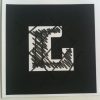
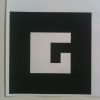
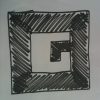
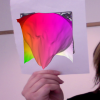
The first photo shows my scribbled marker, which the software is still picking up. I have to say I was surprised at how much I was able to scribble over it and still have it detected. This made me wonder how far from the original marker I could get and still have the software detect it. The second and third images show one of my original markers and a hand-drawn copy of it.
When I tried it with the webcam I found that the software detected the hand-drawn marker pretty well – although I’d say it probably wasn’t quite as accurate as the printed one. Still I was impressed by how well it was able to track it. It made me wonder what possibilities there are for making AR Markers – does it have to be a printed piece of paper? Clearly not – a hand drawn one will work. Could it be three dimensional? Photographed?
This discovery excites me because I see one of the biggest reasons for not using this kind of Augmented Reality marker is the aesthetics. I don’t like their technical, QR code appearance. But if there was a way to make the markers more… analogue… there might be something interesting there.
I know there are also programs available online that can be used to train the software to create custom markers. I might have a go with one of them and see just how far from a QR code the markers can get. I know that Aurasma for example doesn’t need these markers – working with image recognition and geo-tagging.
I’m still not really sure yet exactly what I want to do for this project – other than what I mentioned before about experimenting in the space between digital and analog, physical and ephemeral. As I’ve said before, I don’t want to repeat old mistakes by getting too caught up trying to make the technology work; so I’m very aware at this point that I can’t get too carried away with it. Having said that, after having spent the past few weeks focusing so much on my essay I’m enjoying just playing with Processing for now – it’s helping to get the creative juices flowing once more!