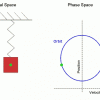
Simple and Circular Motion
Although it may seem counterintuitive, simple harmonic motion (left) and simple circular motion (right) have a great deal in common. If one looks at an object undergoing simple circular motion, it is clear that there are two scales to which an extreme can be reached – a polarized left/right, and an equally polarized up/down. However, looking from the side – only the top and bottom can be seen, and by looking at circular motion from the side it looks exactly like simple harmonic motion.
The physical equations governing these bodies are also quite similar.
Angular Velocity
- A spring in (simple harmonic) motion:
- A pendulum:
Time Period
- Spring:
- Pendulum:
where k is the spring constant, m is the object’s mass, g is gravity, l is the length of the pendulum arm
Given the similarities, it seems reasonable that the product of angular velocity and time period would also be the same. It is: 2 * pi. (Intuition now swings in favor of simple circular motion, rather than the simple harmonic motion of a mass on a spring.)


