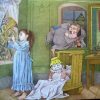
There are three things I’ve heard my wife talk about scaring her as a kid. One was briefly losing her parents on an escalator in a tube station; another was randomly happening upon a Catholic cartoon about Abraham and Isaac playing on TV (why was that dad killing his kid); and the third is the ice baby from Outside Over There, which the goblins leave in place of the main character’s baby sister. Looking at that picture, you can certainly see why – and then later it melts. All of this was inspired by Sendak’s memory of the kidnapping of the Lindbergh baby and how it activated his own anxieties as a kid, since he was being taken care of by his older sister. That makes it even more terrifying, since it’s not (just) myth: it actually happened. It’s a basic modern horror – baby-snatching, the hoariest of local news scares – transformed into grotesque fantasy. That transformation makes it a timeless thing rather than a one-time event, something repeated often enough that we’ve made up stories about it, which in turn makes it seem as inevitable as death or suffering or any of the other things that populate fantasy stories.
Children’s literature tends to paint for kids a picture of the world as worse than it really is – your best friends die, you have to fight for food, everything is trying to kill you, there are monsters everywhere. What made Sendak’s books so great is that, in their allegorical way, they painted a picture of the world as it actually is: sometimes your parents forget you, sometimes your parents try to kill you because God is telling them to. And in doing so, they were far more terrifying than any of the easy scares we tend to be offered as kids. That’s why the hope they all offered at the end of the story felt so real, so full of possibility. It wasn’t empty reassurance. It was a clear-eyed look at the horrors of the world, coupled with a plausible, but imperfect, way out.