One Chance
In six days, every living cell on earth will be dead.
You have one chance.
So begins the first offering from flash game developer AwkardSilenceGames. Like the establishing shot in Lars von Trier’s Melancholia, One Chance doesn’t try to hide its apocalyptic leanings. You play as John Pilgram, a scientist whose cure for cancer quickly mutates into a destructive virus against which humanity is defenseless.
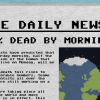
However, One Chance only gives the player newspaper headline glimpses into the state of the world, instead focusing on the lives of John and his family. Each day offers a different set of mundane choices (for instance whether to go to work and scramble to find a cure or simply pass the time in a meadow), which seem to become increasingly meaningless as time passes. The developers give each of these decisions extra weight though, as there is more to the title than the player might assume. Eschewing thirty years of video game evolution, AwkwardSilenceGames neglected to add a reset button. One Chance can only be played through on a computer once, and reloading the page only brings up the final image of the world the player created.
It is an interesting counter-point to the current trend of morality in video games, which typically manifests itself as a sliding “Good/Bad” bar. Slaying innocents moves you one way, while killing evildoers nudges you in the other, and always with the option to return to a save file later and revise your actions. It’s a system that doesn’t reward chivalry as much as consistency, the best endings reserved for those who are the most extreme. In One Chance, however, the choices, almost because of their banality, are much more complex and emotionally involved. The 8-bit graphics and limited control scheme only add emphasis to this, broad strokes of dread that are mostly filled in by the player’s imagination. By removing the ability to reset, One Chance elicits much more realistic decisions which ultimately culminates into a game that doesn’t provide winners or losers, but rather a stark reflection of the person playing it.